Let's not sugarcoat it. Claude AI can write production-grade code, debug entire codebases, explain complex network architectures, draft technical documentation, and pass university-level IT exams — and it can do all of that in under 30 seconds. If you work in IT, you've either already used it, or you know someone who swears by it daily. So the question everybody in Kuwait's tech industry is quietly asking is finally worth asking out loud: Is Claude a genuine threat to our careers?
The short answer is: it depends entirely on who you are and what you do. The long answer — which is what this article is — is far more interesting.
This article is based on our own analysis at ICSA, Anthropic's own published research from March 2026, and real conversations we've had with IT professionals and employers in Kuwait. No panic. No hype. Just a straight read on what's actually happening.
First — What Can Claude Actually Do?
Most people still think of AI tools as fancy autocomplete. That's not what Claude is in 2025. This is a model that can be given a full software brief and return a working multi-file application. It can read an error log and identify not just the bug, but why the architecture produced it. It can plan an entire IT infrastructure, write the configuration files, and walk you through deployment — step by step.
We tested this ourselves. We gave Claude a real-world brief: "Build a student management system for a two-branch institute with JWT authentication, role-based access, and a PostgreSQL backend." Within minutes it returned a structured full-stack architecture with file trees, working Express routes, React components, and database schema. Not perfect — but a working foundation that would have taken a junior developer several days to produce.
Claude generating a full-stack application from a single brief — a task that once took a junior developer several days.
That's not a party trick. That's a real capability shift. And it's not just code. Claude handles network diagrams, writes cybersecurity reports, explains protocols, drafts IT proposals for clients, and answers Cisco exam questions with high accuracy. The breadth is what makes it significant — not just depth in one area, but competence across the entire IT spectrum.
What the Data Actually Says
In March 2026, Anthropic — the company that builds Claude — published something remarkable: a research paper called "Labor Market Impacts of AI: A New Measure and Early Evidence." The unusual thing about this paper is that Anthropic used their own users' real conversation data to figure out which jobs Claude is already performing — not just which jobs it theoretically could do.
They called this metric "observed exposure" — the gap between what Claude is theoretically capable of doing and what it is actually doing right now in professional settings. Anthropic, March 2026
The headline finding from the report was the reassuring one: "limited evidence that AI has affected employment to date." Most outlets ran with that. But buried a few pages deeper was the finding that mattered more: the gap between what AI is currently doing and what it is theoretically capable of doing is enormous — and it's closing fast. When that gap narrows, the labour market impact won't be gradual. Fortune, March 2026
"The workers most exposed to artificial intelligence today are highly educated, deeply experienced, and earning well above average. This flips the conventional wisdom on its head."Nexford University analysis of Anthropic's 2026 Labor Market Report
This is the part that surprises people. We assumed AI would come for the low-skilled, low-paid work first. It's doing the opposite. The most exposed occupations are computer programmers, financial analysts, market researchers, and customer service managers — exactly the kind of roles that required years of education and experience to enter. Anthropic, 2026
The Comment That Shook the Industry
In February 2026, Boris Cherny — the creator of Claude Code, Anthropic's agentic coding tool — appeared on Lenny Rachitsky's podcast and said something that nobody in the industry could ignore:
"I think by the end of the year, everyone is going to be a product manager, and everyone codes. The title software engineer is going to start to go away. It's just going to be replaced by 'builder,' and it's going to be painful for a lot of people."Boris Cherny, Creator of Claude Code, Anthropic — February 2026
This wasn't a random pundit making predictions. This was the person who built the tool. He's watched hundreds of thousands of real coding sessions run through Claude Code. He knows what it can do in ways the rest of us are still catching up to. And he used the word "painful."
Claude generating a full-stack application from a single brief — a task that once took a junior developer several days.
And yet — it's worth pausing on his exact wording. He didn't say developers disappear. He said the title goes away. He said everyone codes. His prediction isn't that fewer people write software — it's that everyone becomes capable of writing software, which collapses the premium you could charge for doing it as a specialist.
Who in IT Is Actually at Risk? An Honest Breakdown
Not all IT roles are equal when it comes to AI exposure. Here's our honest read, based on how Claude actually performs across different areas of IT work:
- 1Junior Developers — High Risk, Right NowEntry-level coding roles are already shrinking. Claude can produce what a junior developer produces, but faster and without requiring a salary, visa, or office space. This doesn't mean juniors are unemployable — but the old path of "grind tutorials → get a junior role → work your way up" is genuinely broken. The companies hiring juniors now want people who can direct Claude, not compete with it.
- 2IT Support Level 1 & 2 — Moderate RiskTicket-based, scripted IT support is exactly the kind of repetitive knowledge work Claude handles well. Many companies are already routing Tier 1 support through AI chatbots. Human support professionals are increasingly being repositioned into escalation roles — which require judgment, not scripts.
- 3Cybersecurity Professionals — Lower Risk, Higher DemandInterestingly, cybersecurity is one of the few IT fields where AI increases both the threat landscape AND the demand for human professionals. Claude can help write phishing scripts, automate penetration testing, and generate exploit code — which means organisations need more human experts to defend against AI-powered attacks. Security is the one field where AI is creating more jobs than it's taking.
- 4Senior Engineers & Architects — Actually BenefitingAnthropic's internal research showed their own engineers are working on significantly more complex tasks since using Claude Code — not fewer. The average task complexity score jumped from 3.2 to 3.8 out of 5 in just six months. Senior engineers are using AI as a force multiplier, getting more done and tackling harder problems. For them, Claude is a power tool, not a replacement.
- 5Network Engineers & Sysadmins — Moderate, ShiftingPhysical infrastructure work stays human. But documentation, configuration scripting, and troubleshooting guides? Claude handles those well. The role is shifting from "knows the commands" to "knows which commands matter" — which is an important distinction.
The ICSA Take: The Honest Truth from Kuwait
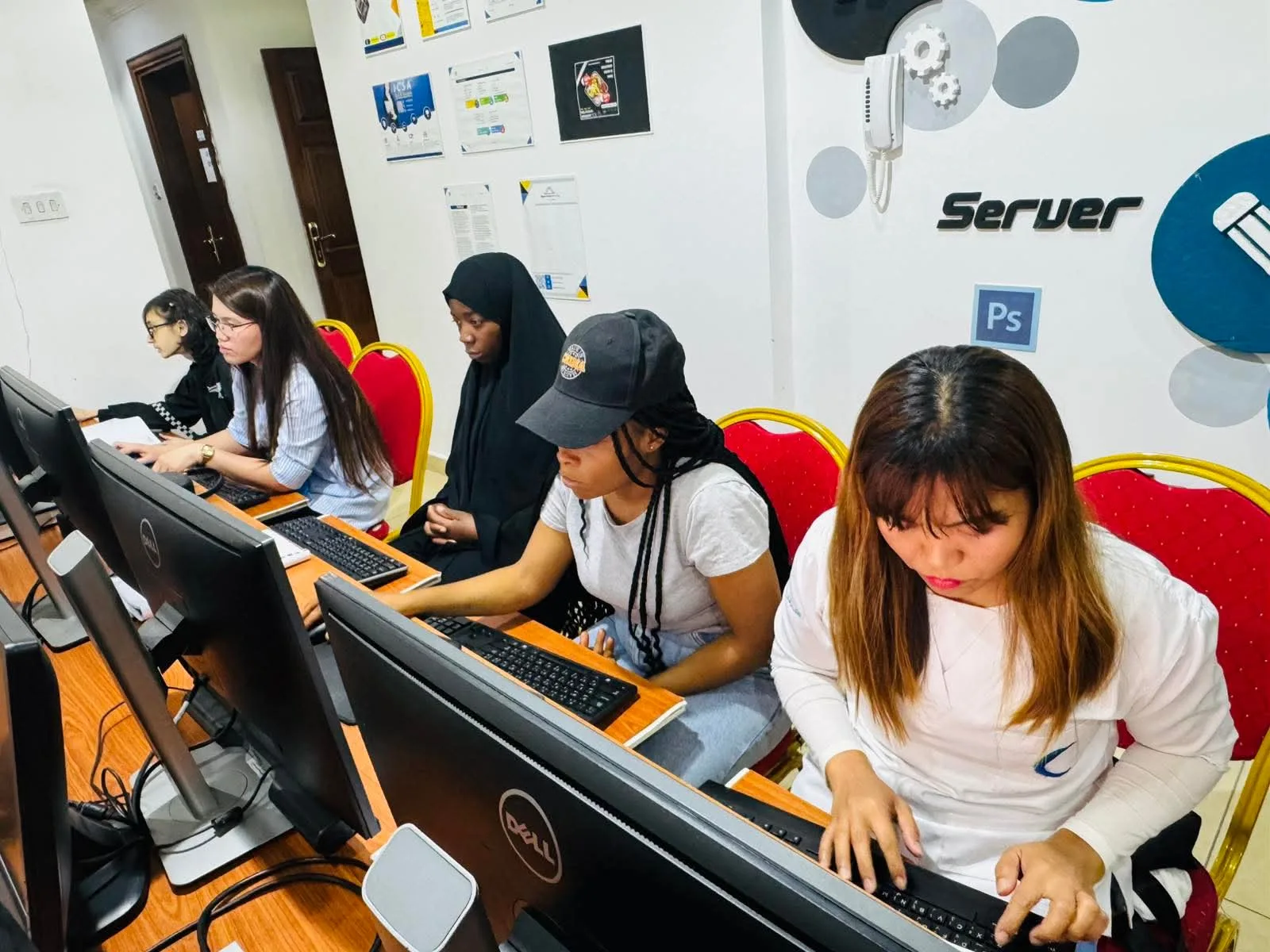
Claude generating a full-stack application from a single brief — a task that once took a junior developer several days.
We've been running IT training in Kuwait for over 25 years. We've watched the industry shift through Windows Server certifications, the rise of web development, the mobile app boom, and now AI. Every single one of those shifts produced anxiety. Every single one of those shifts also created a new wave of well-paying roles for the people who adapted early.
Here's what we've noticed talking to employers in Kuwait right now: they're not looking for less IT talent. They're looking for different IT talent. The job posts that are disappearing are the ones asking for a developer to spend 40 hours building something Claude can scaffold in 4. The job posts that are growing are asking for people who understand systems well enough to evaluate what AI produces, catch what it misses, and own the decision-making.
The biggest mistake we see students make right now is either (a) ignoring AI entirely and assuming it won't affect their career, or (b) assuming AI means they don't need to learn the fundamentals. Both are wrong — and both lead to the same outcome: getting left behind.
AI fluency is becoming what computer literacy was in the 1990s. Back then, knowing how to use a computer was a differentiator. Then it became a baseline requirement. That's exactly where AI is heading — except the curve is steeper and the timeline is shorter.
What You Should Actually Do About This
Panic isn't a strategy. Neither is denial. Here's the practical, grounded response to what Claude and AI tools mean for IT careers in Kuwait in 2025:
- Learn how to use Claude well — not just at all. There is an enormous gap between a skilled Claude user and an average one. A skilled user catches its mistakes, iterates the prompts, questions the output, and combines it with their own domain expertise. An unskilled user accepts whatever it generates and wonders why it doesn't work. Invest in becoming the first kind.
- Go deeper, not broader. AI is very good at breadth and mediocre at deep domain judgment. A developer who genuinely understands distributed systems architecture is not replaceable by Claude. A developer who can write CRUD apps quickly is. Depth is your moat.
- Add cybersecurity to your skillset. Regardless of what else you do in IT, understanding security is becoming table stakes. AI expanding the attack surface means everyone building with tech needs security literacy, and it means security specialists are in growing demand.
- Understand systems, not just syntax. Claude knows syntax. It doesn't know your system. It doesn't understand your organisation's constraints, your client's peculiarities, or the business context of the technical decision. That judgment layer is irreplaceable — but only if you have it.
- Get a qualification that anchors your credibility. As AI makes it easier for anyone to produce the surface appearance of technical work, formal credentials become more important — not less. They signal that your knowledge was independently verified, not just self-reported.
The Counterargument Worth Taking Seriously
Not everyone agrees that Claude represents a fundamental disruption to IT careers. There's a reasonable counterargument, and it deserves a fair hearing.
The companies that aggressively cut technical staff in 2025, attributing it to AI, are now facing serious recruiting challenges. Skilled engineers are avoiding employers with reputations for AI-driven layoffs. The organisations that paired AI with skilled workers — using Claude as an amplifier rather than a replacement — are outperforming the ones that cut staff. LearnDrive, 2026
"AI, in other words, is becoming a technology that rewards those who already know how to use it. The gap between a skilled Claude user and an unskilled one is enormous — not just in output quality, but in what kinds of problems they can even attempt."LearnDrive.org analysis, 2026
There's also the historical argument. The printing press didn't kill writers. The calculator didn't kill mathematicians. The internet didn't kill businesses — it created entirely new categories of them. The people saying "AI will create more jobs than it destroys" have history on their side, even if history doesn't always repeat on the same timeline.

Claude generating a full-stack application from a single brief — a task that once took a junior developer several days.
But "history eventually works out" is cold comfort if you're a 24-year-old in Kuwait applying for your first developer role right now. The short-term pain is real, even if the long-term arc bends toward growth.
Yes — and No. But the "Yes" is Urgent.
Claude AI is not about to walk into your office and fire you. But it is quietly and rapidly reshinking the definition of what technical work is worth paying a human to do. The roles most at risk are those that involve producing well-understood outputs from well-understood inputs — and a significant chunk of traditional IT work fits that description. The roles least at risk are those that involve deep system judgment, creative problem-solving, client relationships, and the kind of contextual knowledge that only comes from actually working inside an organisation.
For students in Kuwait starting their IT careers: the path hasn't closed. But it has changed. The ones who treat Claude as a threat and avoid it will struggle. The ones who treat it as a power tool and master it early will have a serious advantage over everyone who waited.
At ICSA, we've updated the way we teach to reflect this. The goal isn't to teach you to compete with AI. It's to teach you to think at the level above it.
Sources & Further Reading
- Anthropic. (March 2026). Labor Market Impacts of AI: A New Measure and Early Evidence.
- Fortune. (March 2026). Anthropic just mapped out which jobs AI could potentially replace.
- Nexford University. (April 2026). What Anthropic's 2026 AI Labor Market Report Means for Your Career.
- AfroTech. (February 2026). Anthropic's Claude Code Creator Predicts AI Will Phase Out 'Software Engineer' Title By 2026.
- LearnDrive.org. (2026). Will Claude AI Replace Jobs?
- Anthropic Internal Research. (2025). How AI Is Transforming Work at Anthropic.
- HR Dive. (March 2026). Anthropic: AI's influence over the labor market is only beginning to be felt.
- Korn Ferry. (2025). AI Workforce Disruption Report.