A few years ago, the idea of building a fully functional web application without writing a single line of code would have sounded like marketing nonsense. Today, it's genuinely possible — and people are doing it. Entrepreneurs are launching SaaS products on Bubble. Businesses are running their entire client portals on Webflow. Internal tools that used to require a developer team are being shipped by a single operations person using Glide or Retool.
So the question becomes real: if a non-technical person can build an app with no-code tools, why would you spend months learning to code? Is traditional programming becoming obsolete? Or is there something no-code fundamentally can't do that makes coding skills still worth acquiring?
The honest answer involves understanding both what no-code genuinely unlocks and where it hits a very specific wall — and that wall matters more than most no-code advocates admit.
This article isn't anti-no-code. No-code tools are genuinely powerful and have a real place in any builder's toolkit. But it is going to be honest about where they stop — and why that boundary matters if you're making a long-term career decision.
What No-Code Actually Is (and What It Isn't)
No-code platforms are visual development environments — instead of writing instructions in a programming language, you drag components, configure settings, connect databases, and define logic through visual interfaces. The platform handles the code underneath; you just tell it what you want.
The major platforms each occupy a slightly different space:
- 1Webflow — Visual Web DevelopmentBuilds professional, responsive websites with full design control. The gold standard for marketing sites, portfolios, and content-driven pages. Produces real HTML/CSS under the hood. Widely used by designers and agencies in Kuwait's growing digital marketing sector. It's a legitimate professional tool — not a toy.
- 2Bubble — Full Web App BuilderLets you build complex web applications with databases, user authentication, workflows, and custom logic — all without code. Genuinely impressive. Many real startups have launched on Bubble and run at scale. The ceiling is higher than most people expect. But it's also genuinely hard to master — the learning curve rivals learning a framework.
- 3Glide / Adalo — Mobile App BuildersTurn spreadsheets or simple databases into mobile apps. Great for internal tools, simple client apps, and prototypes. Not the right choice for complex consumer applications that need custom performance or deep integrations.
- 4Zapier / Make — Automation ToolsConnect different apps and automate workflows between them without code. Not for building user-facing products, but incredibly powerful for business process automation. High demand in Kuwait's SME market for people who can configure these systems intelligently.
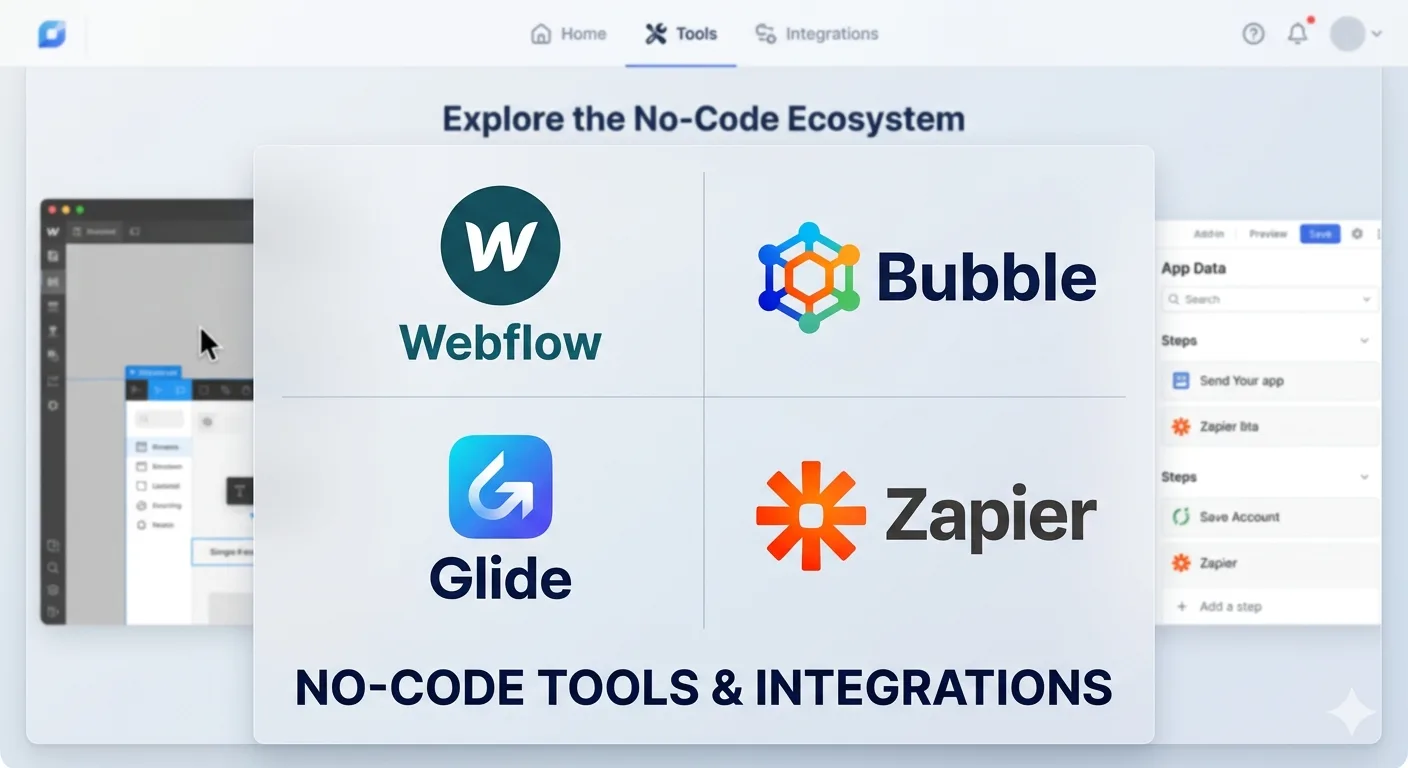
No-code tools span a wide spectrum — from marketing site builders to full application development platforms — each with its own ceiling and use case.
Where No-Code Is Genuinely Brilliant
Let's be fair: no-code has unlocked real value for real people. Here's where it genuinely shines:
- Prototyping and validation. Want to test whether your business idea has legs before investing in a developer? Build a working prototype on Bubble in a week. Get real users. See if it works. If it doesn't, you've saved months and significant money. No-code makes validation cheap and fast.
- Small businesses and solo operators. A restaurant, a boutique, a consultancy, or a freelancer who needs a professional website and a simple booking or order system can get everything they need from Webflow or Squarespace without hiring a developer. This is entirely appropriate — and it works well.
- Internal tools and automation. A company's operations team can automate repetitive processes, build internal dashboards, and connect their software tools using Zapier or Make — saving hours of manual work weekly without any developer involvement. This is one of the highest-ROI applications of no-code.
- Speed for experienced builders. Interestingly, no-code tools are often most powerful in the hands of people who do understand code — because they know exactly what's possible and can move faster on standard components. Many developers use Webflow for client sites precisely because it's faster than building from scratch.
"No-code didn't kill developers — it killed the market for overpriced developers doing simple things. That's not the same thing."ICSA Editorial, 2025
Where No-Code Hits the Wall
Here's the part no-code advocates tend to gloss over. Every no-code platform has a ceiling — a point at which the constraints of the visual system make it impossible or impractical to build what you actually need. That ceiling is higher than it used to be, but it exists, and it matters.
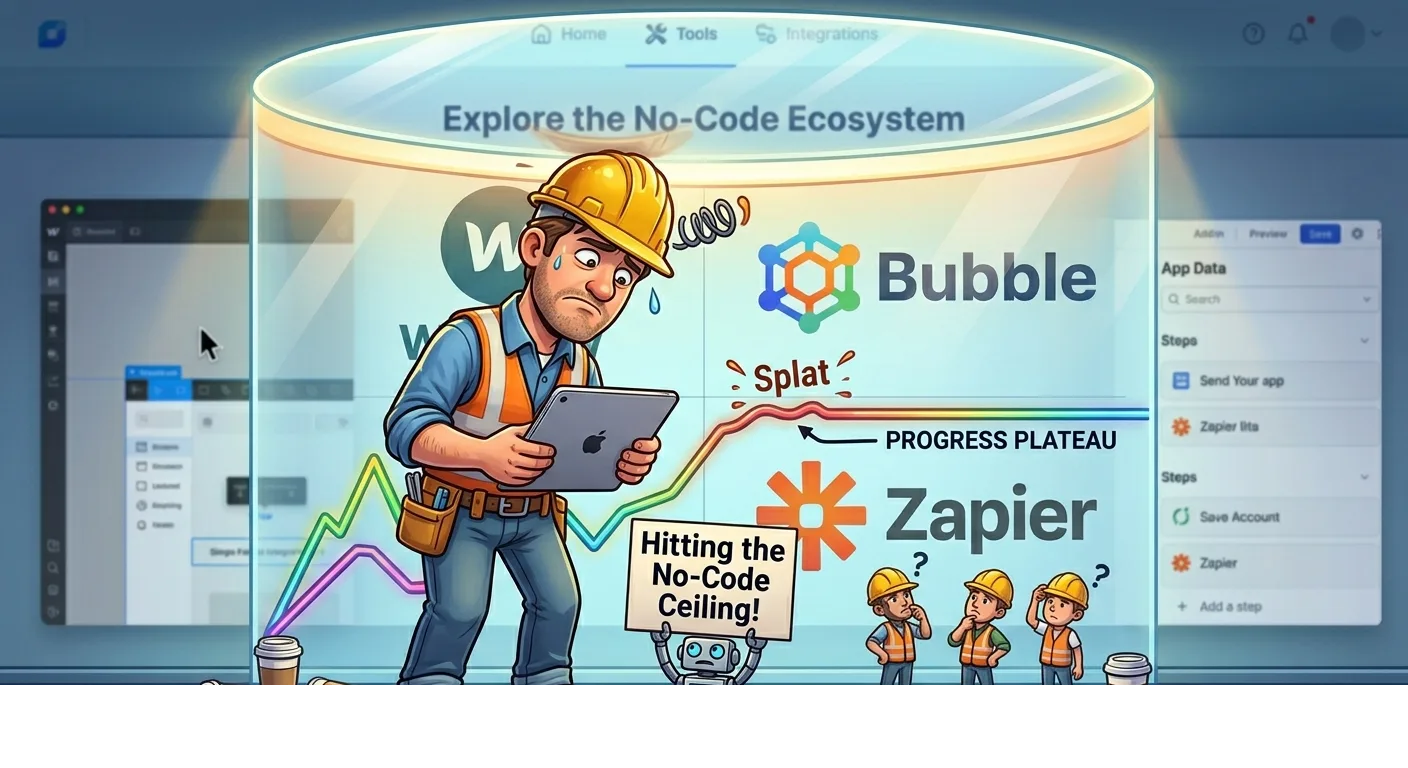
Every no-code platform has a ceiling. The question isn't whether you'll hit it — it's whether what you're building requires going beyond it.
Beyond the technical ceiling, there's a career ceiling too. No-code is not a recognised professional skill in Kuwait's formal job market in the same way that HTML, CSS, JavaScript, or Python are. A Webflow certification won't appear on a job description at a bank, government ministry, or technology company. It's a tool — a very useful tool — but it doesn't translate into the same career ladder that traditional development skills do.
If your goal is to work for a company as an employed developer or IT professional, no-code skills alone won't get you there. If your goal is to build your own product or run a digital business, they might be exactly what you need.
So — Is Learning to Code Still Worth It in 2025?
Yes. But let's be precise about why, because the reasons have shifted.
The old reason to learn code was: "Coding is a rare skill and companies will pay well for it." That's still true, but less exclusively so. Both no-code tools and AI coding assistants have compressed the scarcity premium for basic development work.
The new reasons to learn code are more interesting and more durable:
- Code gives you understanding that no-code can't. When you understand how software actually works — how data flows, how servers respond, how browsers render, how databases store — you can use any tool, including no-code tools, far more powerfully. You know what's possible. You know what's happening underneath. That understanding makes you a better builder regardless of the tool.
- Code lets you escape the platform ceiling when it matters. Every serious no-code project eventually needs something the platform can't do. Custom integrations. Performance fixes. Unusual data structures. The builder who can drop into code when needed — even occasionally — has dramatically more range than the one who can't.
- Code is the language of employment in Kuwait's formal sector. If you want a job at a bank, a government department, a telecom company, or an enterprise technology firm in Kuwait, you need real development skills. These organisations don't run on Bubble.
- AI makes coding more accessible, not less relevant. AI tools make it faster to write code — but they don't remove the need to understand what the code is doing. If anything, AI coding tools are most useful to people who already understand programming concepts and can evaluate the output critically. They're least useful to people trying to learn by outsourcing everything to AI from day one.
The Smartest Play: Use Both
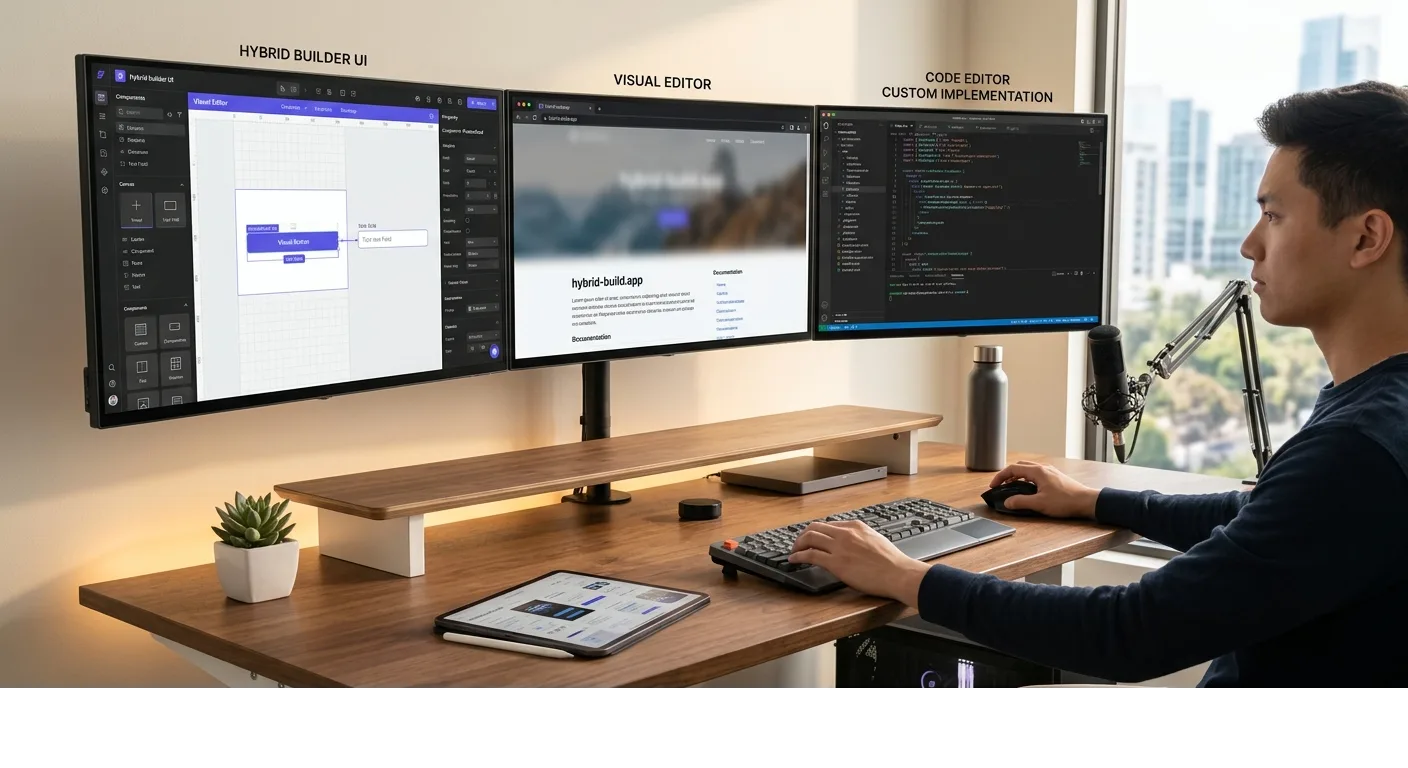
The most effective builders in 2026 use no-code tools for speed where they work and drop into real code where they don't — the hybrid approach beats either extreme.
The framing of "no-code vs. coding" is a false binary. The most effective digital builders in 2025 aren't choosing one or the other — they're using no-code tools for the parts they're suited to and real code for the parts that need it.
A web developer who also knows Webflow can build client marketing sites in a fraction of the time. A developer building a startup MVP can use Bubble to validate the idea, then rewrite critical components in code when performance matters. A freelancer who understands both has significantly more tools to offer clients — and a higher ceiling on what they can charge.
In Kuwait specifically, the freelance and digital agency market is growing fast. Clients want results — they don't care whether it was built in Webflow or React. The builders who can deliver quality work at speed, using the right tool for the job, are the ones winning. The skill isn't "no-code" or "coding" — it's knowing which to use when.
Practical Guidance: Where to Start
- If you want a job at a company: Learn to code properly. HTML, CSS, JavaScript as a foundation — then a framework (React or Vue) or a backend language (Node, Python) depending on your interest. No-code skills are a bonus on top, not a substitute.
- If you want to build your own product or freelance: Start with Webflow for websites — it's genuinely professional-grade and the market in Kuwait has real demand for people who use it well. Layer in basic JavaScript understanding over time so you can customise when needed.
- If you're an entrepreneur or business owner: Learn just enough no-code to build and test your own ideas without depending on a developer for every change. Bubble for app logic, Webflow for marketing, Zapier for automation. The ability to move fast without a technical co-founder is genuinely valuable.
- If you're already a developer: Add Webflow to your toolkit — it'll make you faster on a significant category of client work. Don't dismiss no-code as beneath you; it's a productivity tool, and ignoring it is like a carpenter refusing to use a nail gun.

Whether built in code or no-code, what ultimately matters is delivering a working product — the tool is secondary to the outcome.
No-Code Is a Tool. Coding Is a Foundation. You Want Both.
No-code hasn't made coding obsolete — it's made certain kinds of coding less necessary for certain kinds of projects. That's a real and meaningful shift. The person who once needed a developer to build a brochure website doesn't anymore. But the person building the systems that run organisations, securing the infrastructure they run on, and creating the software that drives real business outcomes still needs to understand how software actually works.
The smartest move in 2025 is to treat no-code and coding as complementary rather than competing. Learn the fundamentals of coding because they give you genuine understanding of how digital systems work. Use no-code tools because they make you faster on the right kinds of projects. The builder who combines both is more versatile, more hireable, and more capable than the one who picked a side.
At ICSA, our web development courses teach real coding foundations — HTML, CSS, JavaScript, and beyond — while we also incorporate modern tools and workflows that professional builders actually use. If you want to understand how to structure your learning, our team can help you map the path that fits your specific goals.