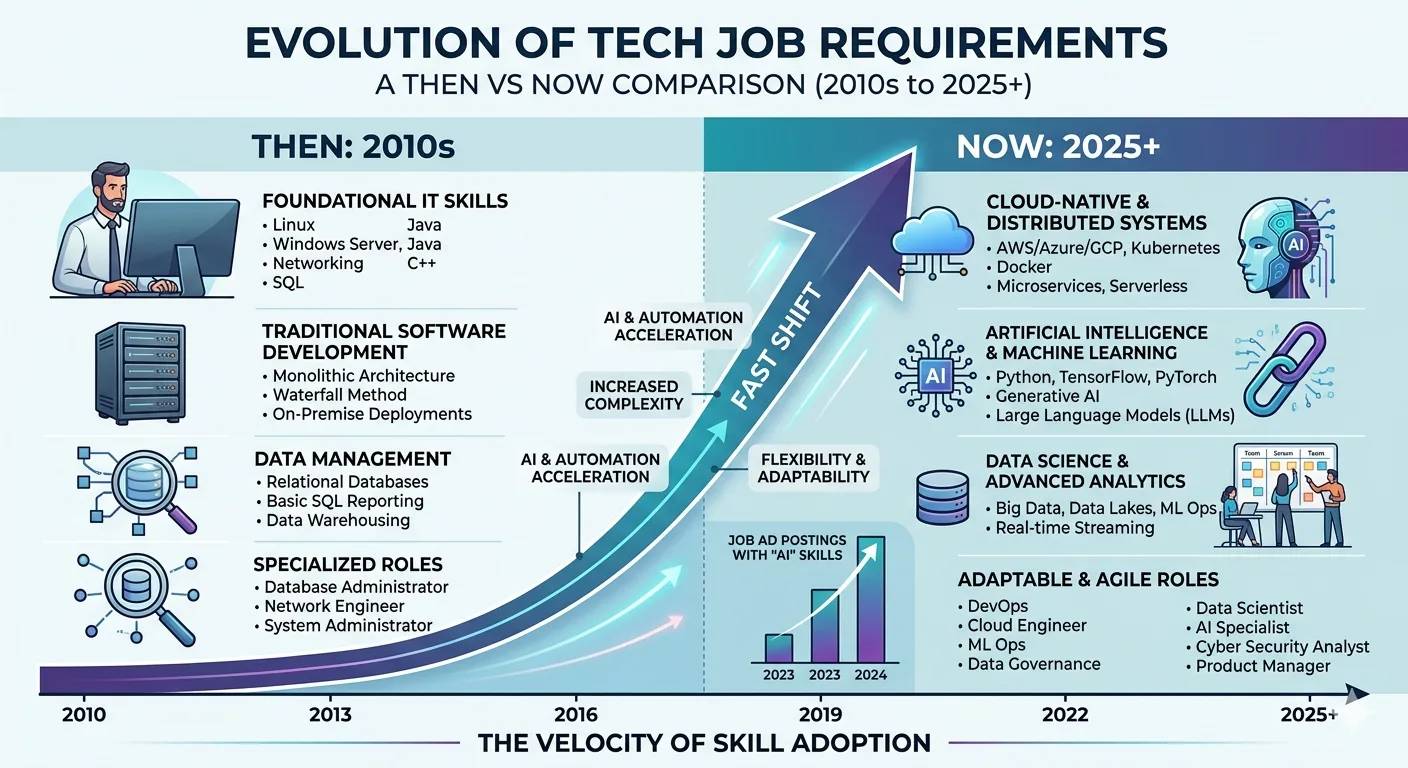
Five years sounds like a long time. It isn't. 2030 is closer than the year COVID started. And between now and then, the job market in IT — globally and right here in Kuwait — is going to look radically different from what it does today. The roles that are growing are specific. The skills they require are learnable. Most people just haven't started yet.
This isn't a list of buzzwords. We've looked at what Kuwait's employers are actually asking for, what global tech trends are doing to entry requirements, and what the industry data shows about where demand is heading. The five skills below aren't predictions — they're already in motion. The gap between people who have them and people who don't is already visible. By 2030, it'll be a chasm.
None of these skills require a computer science degree. Every single one of them can be started with a short course, consistent practice, and genuine curiosity. The barrier isn't access — it's awareness. That's what this article is for.
Why Most People Are Already Behind
Here's the uncomfortable truth: the people who will dominate the job market in 2030 started building these skills in 2023 or 2024. They're already 1–2 years ahead of you. That's not said to discourage you — it's said to make the urgency real, because the typical response to "you should learn X" is to bookmark it and come back never.
The labour market doesn't wait for you to feel ready. Employers in Kuwait's private sector, government tech divisions, and the growing startup ecosystem are already rewarding the skills on this list with higher salaries, faster hiring, and more career stability. The delay between "this skill becomes important" and "this skill becomes a baseline requirement" is shrinking every year. What was a differentiator in 2022 is becoming a minimum expectation in 2026.
"AI fluency is becoming what computer literacy was in the 1990s. Back then, knowing how to use a computer was a differentiator. Then it became a baseline requirement. The same curve is happening with these skills — except it's steeper and faster."ICSA Editorial — based on 23 years of watching Kuwait's IT job market shift
Claude generating a full-stack application from a single brief — a task that once took a junior developer several days.
Skill #1 — AI Fluency (Not AI Hype)
This is not "learn to use ChatGPT." That bar is already too low. AI fluency means understanding how to get genuinely useful, accurate, production-ready output from AI tools — and, critically, knowing when the output is wrong. The person who can do that is worth far more than the person who just knows AI exists.
By 2030, AI tools will be embedded into almost every digital workflow. Writing code, drafting documents, analysing data, managing infrastructure — there will be an AI layer in all of it. The question employers will ask is whether you can work above that layer — directing it, evaluating it, and making the judgment calls it can't.
- What this looks like in practice: Prompt engineering, understanding model limitations, combining AI output with domain expertise, knowing which tasks are AI-appropriate and which require human judgment.
- Who it's most urgent for: Developers, content professionals, analysts, IT support staff — basically anyone whose job involves producing digital output.
- Where to start: Use AI tools daily for real work, not just experiments. Learn to evaluate the output critically. Read about how LLMs actually work — not technically, but conceptually.
Knowing AI exists is not AI fluency. "I use ChatGPT sometimes" will not be a differentiator by 2030 — it will be the equivalent of saying "I can use Google." The skill is in depth of usage, not awareness of existence.
Skill #2 — Cybersecurity Fundamentals
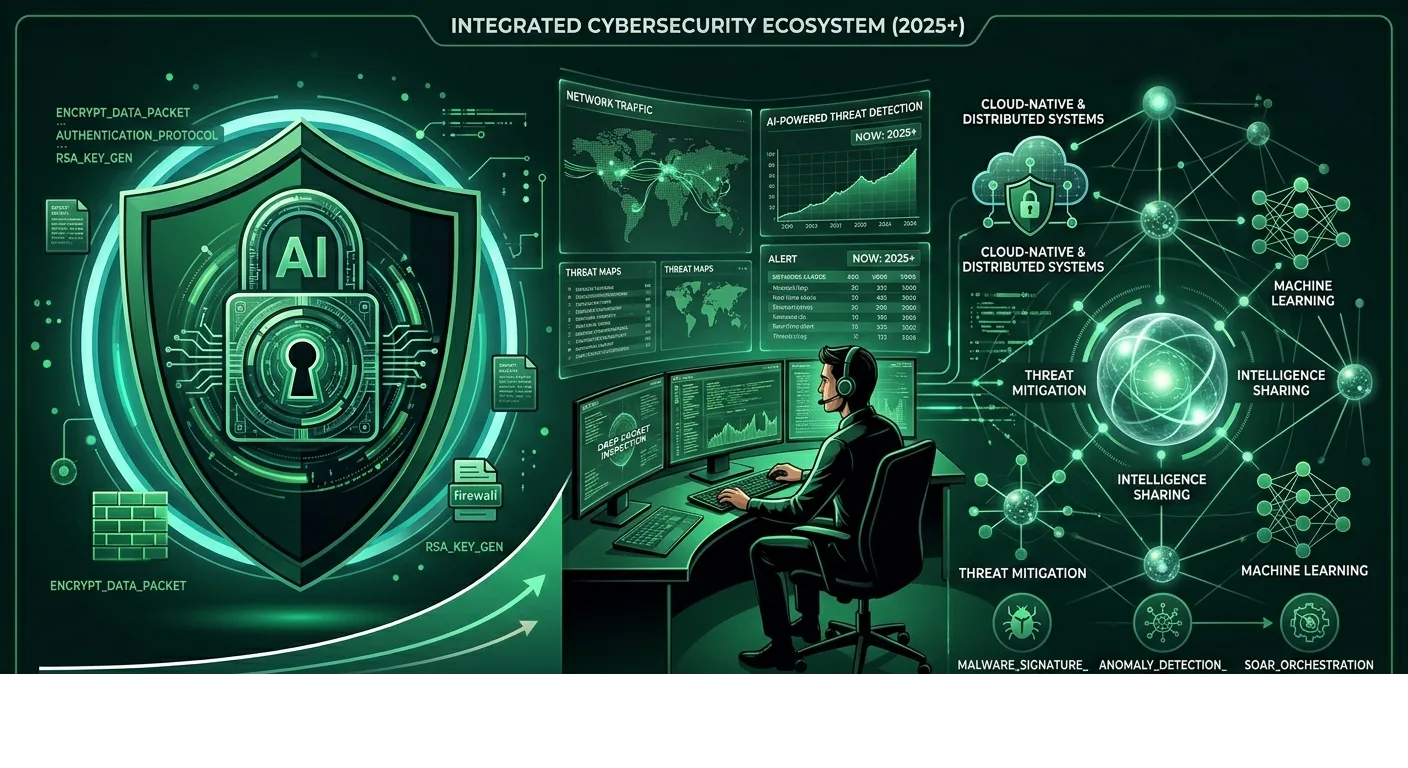
Cybersecurity used to be a specialist lane. In 2030, it will be table stakes for anyone building, maintaining, or managing digital systems. The reason is straightforward: the attack surface is expanding faster than the workforce protecting it. AI tools are making it easier to launch sophisticated attacks. The Internet of Things is adding billions of new entry points. Remote work permanently expanded every organisation's vulnerability footprint.
You don't need to become a penetration tester. But you do need to understand how attacks work, what common vulnerabilities look like, and how to build systems that don't make a security professional cry. Employers across Kuwait — from banks to government departments to logistics companies — are increasingly requiring a baseline of security awareness from all technical hires, not just dedicated security staff.
Claude generating a full-stack application from a single brief — a task that once took a junior developer several days.
Skill #3 — Cloud Computing Basics
Here's a number that should get your attention: the vast majority of enterprise workloads globally have already moved to the cloud or are in the process of moving. AWS, Microsoft Azure, and Google Cloud now run most of the internet. If you work in IT and don't understand how cloud infrastructure works, you are increasingly working with a blindfold on.
This doesn't mean you need to become a cloud architect. It means you need to understand the concepts — what a virtual machine is, how storage and networking work in a cloud context, what "serverless" means, why organisations choose multi-cloud setups. Even developers who never touch infrastructure directly need this context to build things that actually deploy correctly.
In Kuwait specifically, the rollout of national cloud infrastructure and the expansion of multinational tech companies in the GCC region means that cloud-literate professionals are in growing demand at every level — from junior admins to senior consultants.
- Start with: AWS Cloud Practitioner or Microsoft Azure Fundamentals — both are beginner-level certifications that provide genuine foundational knowledge.
- Then move to: Understanding how to deploy and manage real applications in a cloud environment — not just pass the cert exam.
- Real goal: Being able to have an intelligent conversation about cloud architecture, cost, and security with any technical team.
Skill #4 — Data Literacy
Data literacy doesn't mean becoming a data scientist. It means being able to read, question, and act on data — which is rapidly becoming a requirement for anyone in a professional role, not just analysts. By 2030, decisions made without data will be seen the same way we now see decisions made without internet research: uninformed.
In IT specifically, data literacy means understanding how databases work, being able to write basic SQL queries, knowing how to visualise data meaningfully, and — critically — being able to spot when data is being misread or misrepresented. AI is producing more data outputs than ever. The people who can evaluate those outputs intelligently are disproportionately valuable.
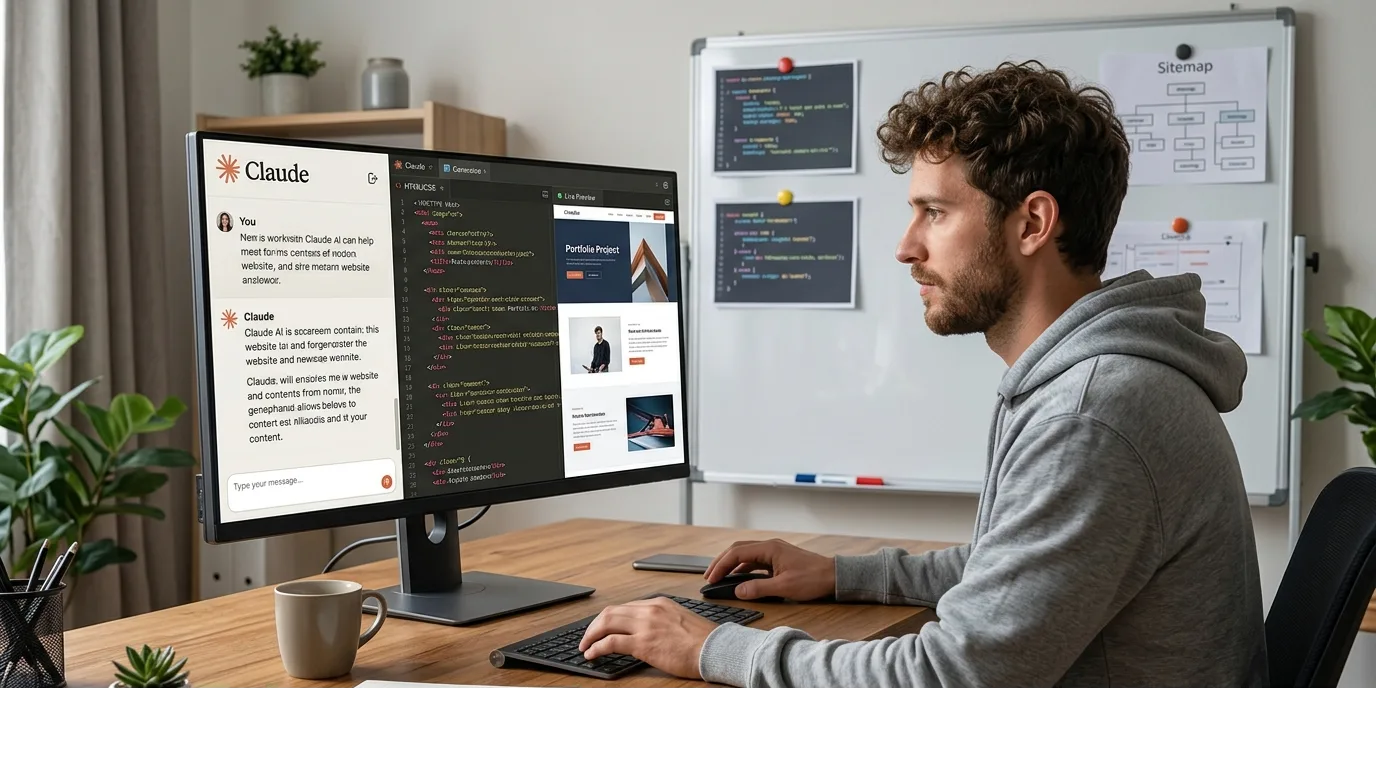
Claude generating a full-stack application from a single brief — a task that once took a junior developer several days.
"Data literacy is the new literacy. Within a decade, the inability to interpret data will be as limiting as the inability to read."World Economic Forum Future of Jobs Report
Skill #5 — Communication & Systems Thinking
This one surprises people. It's not technical. And that's exactly why it matters.
As AI handles more of the rote technical execution, the humans in IT are increasingly being asked to do the things AI genuinely struggles with: understand what a client actually needs, translate that into a system design, explain a complex technical decision to a non-technical stakeholder, and own the outcome. These are not soft skills. They are hard competitive advantages that take years to develop and cannot be automated.
Systems thinking specifically — the ability to see how the pieces of a system interact, where the bottlenecks are, what breaks under load, what a change in one part does to the rest — is the mental model that separates good IT professionals from great ones. It's also the skill that makes every other skill on this list more powerful.
- Communication: Practice explaining technical concepts to non-technical people. If you can't, you don't understand them as well as you think. This is also what makes you promotable.
- Systems thinking: Study how real systems fail. Read about architecture decisions at scale. Understand that every shortcut has a consequence somewhere downstream.
- Why it's #5 on this list but arguably #1 in importance: Because it multiplies every other skill. A cybersecurity professional who communicates well earns significantly more than one who can't. A cloud architect who understands the business context of a system builds significantly better solutions.
The ICSA Take: A Kuwait Perspective

Claude generating a full-stack application from a single brief — a task that once took a junior developer several days.
We've been training IT professionals in Kuwait since 2001. We've watched every major wave — the rise of networking certifications, the web development boom, the mobile era. In each cycle, the people who moved early won. The people who waited until it was obvious paid a premium in time, effort, and missed opportunity.
What we're seeing right now from Kuwait's employers is a consistent theme: they can find people who know the technology. What they can't find is people who know the technology and understand how to apply it in a real business context, communicate about it clearly, and keep up as it evolves. That intersection is where every skill on this list lives.
Five Skills. Five Years. One Decision.
AI fluency, cybersecurity fundamentals, cloud basics, data literacy, and communication/systems thinking — these aren't exotic future concepts. They're the skills that are already separating the people getting hired from the people getting overlooked in 2025. By 2030, they'll be the floor, not the ceiling.
You don't need to master all five at once. You need to pick one, start it this week, and build momentum. The worst outcome is another year passing where you meant to start but didn't. The job market won't wait for that.
At ICSA, every single one of these skill areas is covered in our programs — taught by instructors who work in the industry, not just teach about it. If you're not sure where to begin, start with a conversation with our team.